

Substack made paid newsletters mainstream. beehiiv built a business toolkit around them. In 2026 the two platforms overlap more than ever — but they charge you in completely different ways, and that difference compounds as you grow.
This beehiiv vs Substack comparison skips the hype. Below you’ll find real fee math at four revenue levels, an honest look at ownership and growth tools, and a straight answer on who should switch — including the case where Substack genuinely wins.
Disclosure: This article may contain affiliate links. If you buy through them, we may earn a commission at no extra cost to you. It never affects our rankings or verdicts. Learn more →
One more note before we start: as far as we could find, Substack does not run an affiliate program, so we earn nothing if you choose it. Our beehiiv links may pay us a commission — but as the math below shows, there are real cases where Substack is the right call, and we say so.
TL;DR
- Pick Substack if… you’re starting from zero, you don’t want any upfront cost, and you’re not sure paid subscriptions will work yet. Free to publish at any list size; you only pay when readers pay you.
- Pick beehiiv if… you earn (or plan to earn) roughly $500+/month from subscriptions or ads, want a custom domain and full list ownership, and want growth tools like Boosts and the ad network. At $20,000/year in subscription revenue, beehiiv saves you about $700/year over Substack — and the gap widens from there.
beehiiv vs Substack fees: what each platform actually costs
Substack’s model: free to publish, then 10% of every paid subscription payment, plus Stripe processing. Stripe charges 2.9% + $0.30 per transaction, plus a 0.7% recurring-billing fee on subscriptions (per Substack’s help center and Stripe’s pricing page, accessed 2026-10-16).
beehiiv’s model: a flat monthly plan, plus the same Stripe processing on paid subscriptions. beehiiv takes 0% of your subscription revenue (beehiiv blog and pricing page, accessed 2026-10-16). Important: beehiiv renamed its plans and raised prices on October 1, 2026. Scale became Lite, Max became Pro, and Launch became Free (reported by The Verge on October 2, 2026, and by EmailToolTester; both accessed 2026-10-25). Paid subscriptions require Lite, which starts at $59/month on monthly billing for up to 1,000 subscribers and rises with list size.
Total annual cost by newsletter revenue
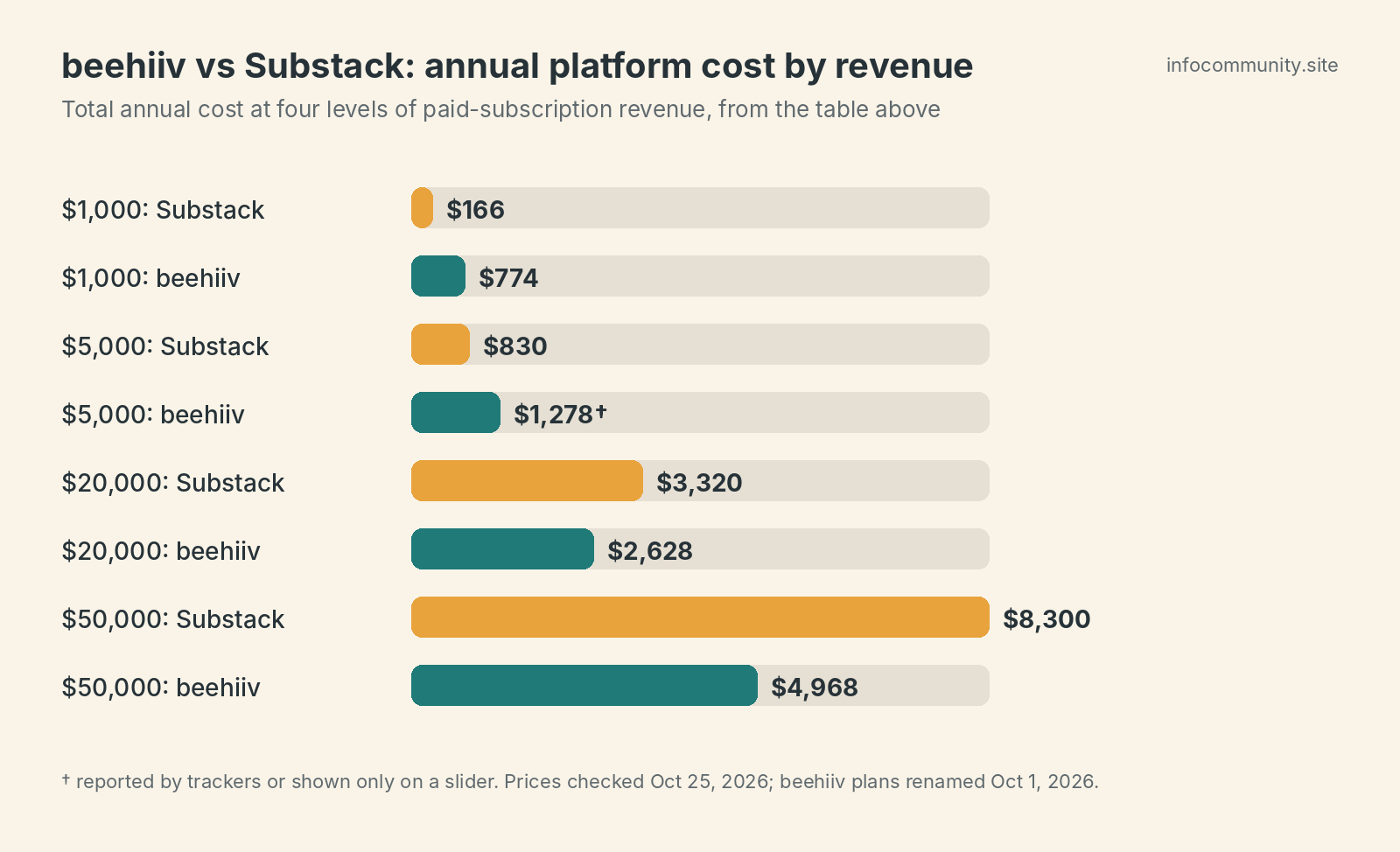
| Annual newsletter revenue | Substack total fees | beehiiv total cost (Lite) | Difference |
|---|---|---|---|
| $1,000 | $166 | $774 | Substack cheaper by $608 |
| $5,000 | $830 | $1,278† | Substack cheaper by $448 |
| $20,000 | $3,320 | $2,628 | beehiiv cheaper by $692 |
| $50,000 | $8,300 | $4,968 | beehiiv cheaper by $3,332 |
How we calculated
- Subscription price assumption: $10/month per paid subscriber, billed monthly. This is a common price point; annual billing changes the math slightly (fewer $0.30 fixed charges).
- Substack fees: 10% platform fee + 2.9% + 0.7% Stripe fees on gross revenue, plus $0.30 per transaction (12 transactions per subscriber per year). That works out to roughly 16.6% of gross revenue at this price point.
- beehiiv cost: Lite plan at assumed list sizes, billed monthly: $59 at 1,000 subs, $79† at 2,500, $109 at 5,000, $139 at 10,000. The $59, $109 and $139 figures are reported consistently by The Verge (via ppc.land), EmailToolTester and omidsaffari.com, which says it read beehiiv’s live pricing slider on 2026-10-09; the $79 figure comes from EmailToolTester alone. We could not read beehiiv’s own slider directly. Stripe fees are the same as above: 2.9% + $0.30, plus a 0.7% recurring-billing fee that we assumed; confirm it in your own Stripe dashboard.
- Assumed list sizes: 1,000 total subscribers at $1,000 revenue; 2,500 at $5,000; 5,000 at $20,000; 10,000 at $50,000. Your free-to-paid conversion may differ, which changes beehiiv’s price tier.
- Excluded: Substack’s optional one-time custom domain fee (reported at $50†); beehiiv annual-billing discounts (the annual equivalents the trackers list imply roughly 13–17% off monthly).
- Sources: ppc.land (citing The Verge), emailtooltester.com and omidsaffari.com for beehiiv prices; support.substack.com and stripe.com/pricing for fees. See the list at the end of the article.
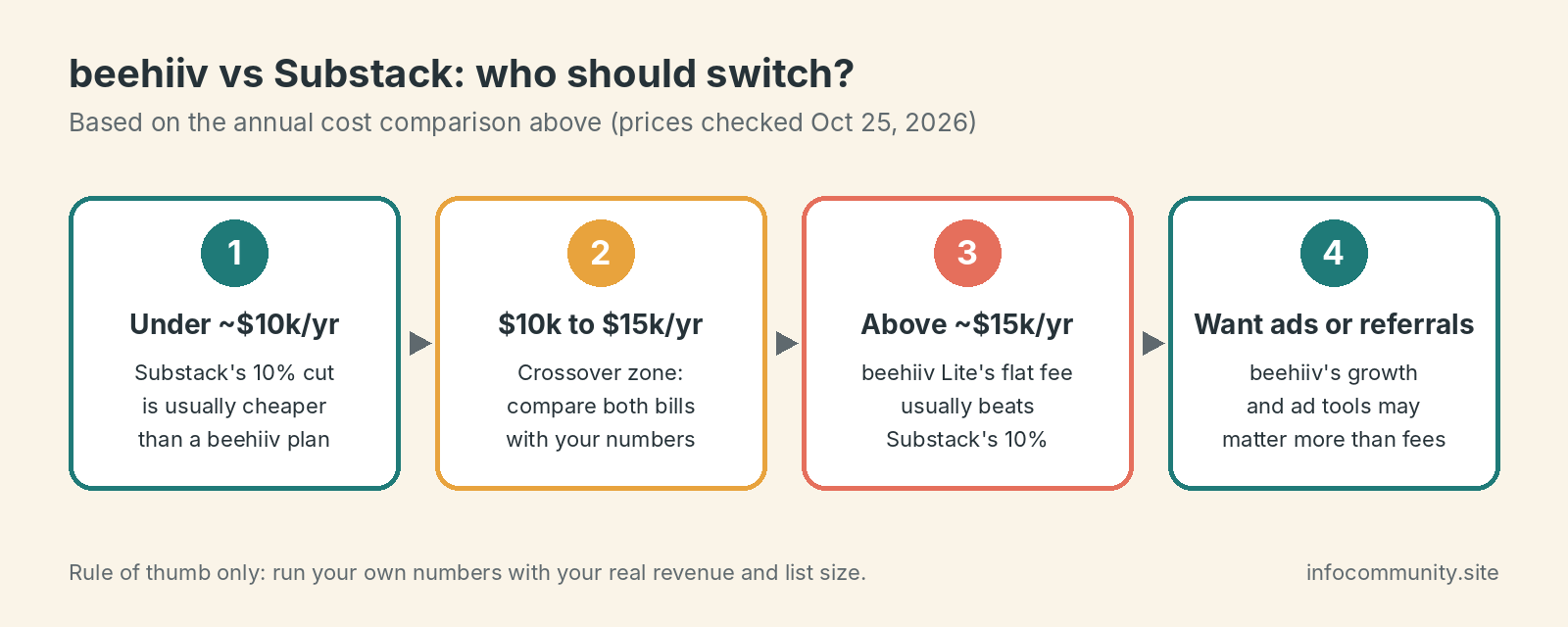
The takeaway is not “beehiiv is cheaper.” It’s that the cheaper platform depends on your revenue. Under our list-size assumptions, below roughly $10,000–$15,000 a year, Substack’s zero-upfront model wins on pure cost. Past that, Substack’s 10% becomes a growth tax, and beehiiv’s flat fee pulls ahead — permanently.
Ownership and Portability
This is where the two platforms differ philosophically.
Substack lets you export your email list and posts. That part is real. But a custom domain is a paid add-on (reported at a one-time $50†), and your publication’s discovery is deeply tied to Substack’s network, app, and Notes feed. Leave, and you lose most of that discovery engine.
beehiiv includes a custom domain on Lite and above (and reportedly no longer on the free plan after the October 2026 changes†, per eden.so, accessed 2026-10-16). You can export your subscriber list at any time. Your site lives on your domain, which means your SEO equity belongs to you, not the platform.
Both platforms let you take your email list with you. On beehiiv’s paid plans, your domain, design and SEO sit under your own control from day one; on Substack, a custom domain is an add-on and discovery stays tied to the platform.
Growth Tools
Substack’s growth engine is its recommendation network and Notes, its built-in social feed. Writers recommend each other’s publications, and Substack promotes this network as a major source of new subscribers. That’s genuinely powerful — and it’s also platform-dependent. The audience growth you get from Substack’s network is strongest while you stay on Substack.
beehiiv offers (per beehiiv.com/features, accessed 2026-10-16):
- Boosts: a marketplace where newsletters pay each other for subscriber referrals — a paid, controllable version of recommendations.
- Recommendation network: free cross-promotion between beehiiv newsletters.
- Referral program: built-in tools for readers to earn rewards for sharing.
- Ad network: beehiiv matches sponsors with newsletters and handles the paperwork.
Substack’s network is bigger and more organic. beehiiv’s tools are more transactional but more controllable — you can turn growth on with budget instead of waiting for recommendations.
Monetization Options
Substack: paid subscriptions (10% cut), plus the ability to include affiliate links. No native display ads and no sponsorship marketplace†. Substack reportedly requires a $5/month or $30/year minimum price for paid plans† (Substack help center, accessed 2026-10-16).
beehiiv: paid subscriptions (0% platform fee), the ad network, Boosts (earning money by recommending other newsletters), and digital products. If your model is “sponsorships first, paid subs later,” beehiiv is built for that. Substack mostly isn’t.
Deliverability and the Ownership Angle
Both platforms handle sending infrastructure for you. The difference is control. On beehiiv, you can send from your own domain with your own sending reputation. On Substack, sending is tied more closely to Substack’s own infrastructure†, which is convenient but gives you fewer levers.
Neither platform publishes independent deliverability benchmarks, so we won’t invent numbers here. What we can say: if inbox placement ever becomes a problem, beehiiv appears to give you more levers to pull (custom sending domain, list hygiene tools, segmentation by engagement)†.
beehiiv vs Substack: who should switch (and who shouldn’t)
Stay on Substack if:
- You’re earning under ~$1,000/month and cost simplicity matters more than features.
- A meaningful share of your growth comes from Substack recommendations and Notes.
- You want zero monthly bills, period.
Switch to beehiiv if:
- You’re past roughly $10,000–$15,000/year in subscription revenue (see the table).
- You want sponsorship revenue without giving up a cut.
- You want your own domain and brand from the start.
Moving is doable: you export your list and posts from Substack and import them into beehiiv. Our step-by-step guide to migrating from Substack to beehiiv covers the order of steps, paid subscribers and what doesn’t carry over.
Also comparing other tools? See our MailerLite vs Kit comparison and our guide to 7 cheaper Mailchimp alternatives.
FAQ
Is beehiiv really 0% fees on paid subscriptions?
Yes — beehiiv takes no platform cut. You still pay Stripe processing (2.9% + $0.30 per transaction; a recurring-billing fee may also apply, so confirm it in your Stripe dashboard). Source: beehiiv pricing/features pages, accessed 2026-10-16.
Didn’t beehiiv just raise its prices?
Yes. On October 1, 2026, beehiiv renamed its plans (Launch→Free, Scale→Lite, Max→Pro) and raised prices. The Verge reported that Lite at 10,000 subscribers went from $109 to $139 a month (via ppc.land, accessed 2026-10-25). We have not confirmed when existing customers move to the new prices†. The beehiiv figures in this article use the new pricing.
What percentage does Substack actually take?
10% of each payment, plus Stripe’s 2.9% + $0.30 and a 0.7% recurring billing fee. On a $10/month subscription, total fees are about $1.66 — roughly 16.6%, not 10%.
Can I leave Substack and keep my subscribers?
Yes. You can export your email list and your posts. What you can’t take is Substack’s discovery network — recommendations and Notes traffic stay behind.
Is Substack free forever?
Free to publish at any list size, yes. You only pay when you turn on paid subscriptions. For a beginner with no revenue, that’s a real advantage no flat-fee platform matches.
Does Substack have an affiliate program?
Not that we could find. If a review site pushes beehiiv, check for a disclosure. Ours is at the top of this article.
† Price or detail reported by third-party trackers or not published as static text on the vendor’s page (many vendors show prices on an interactive slider). Confirm on the vendor’s live page before you buy.
Sources and method
Prices and plan limits on this page were checked on the dates shown below. We have not yet published our own hands-on test results for this comparison; where we add them, we will say so and show screenshots.
- ppc.land, citing The Verge (accessed 2026-10-25)
- emailtooltester.com (accessed 2026-10-25)
- omidsaffari.com (accessed 2026-10-25)
- beehiiv.com (accessed 2026-10-16)
- beehiiv.com (accessed 2026-10-16)
- support.substack.com (accessed 2026-10-16)
- stripe.com (accessed 2026-10-16)
- beehiiv.com (accessed 2026-10-16)