

Mailchimp used to be the default answer to “which email tool should I use?” In 2026, that answer is harder to defend. Two rounds of price hikes under Intuit ownership, plus a free plan that now stops at 250 contacts†, mean a lot of small businesses are paying more each year for the same sends.
This guide compares seven cheaper Mailchimp alternatives against Mailchimp itself. Prices come from vendors’ official pricing pages where we could read them, and from third-party pricing trackers where we could not (many vendors show prices on an interactive slider). Figures marked † come from trackers and may differ from the live page. Everything was checked on October 16, 2026, and where sources conflict, we say so instead of guessing.
Disclosure: This article may contain affiliate links. If you buy through them, we may earn a commission at no extra cost to you. It never affects our rankings or verdicts. Learn more →
Why people are leaving Mailchimp in 2026
Two changes drove the current wave of switches:
- An across-the-board price increase in April 2026. Pricing tracker SMTPedia documented an 11–13% increase on all paid plans in April 2026†, part of what it describes as a steady Intuit-era escalation: Essentials went from $9.99 to $13/month between 2022 and 2023, and Standard from $14.99 to $20/month (smtpedia.com, accessed 2026-10-16).
- The free plan shrank to 250 contacts. Mailchimp’s free tier was once famous at 2,000 contacts. It has since been cut twice, and now sits at 250 contacts† with 500 sends per month, no automation beyond a single welcome email, and forced Mailchimp branding (smtpedia.com, accessed 2026-10-16). That is a demo, not a free plan.
The result: a 5,000-contact list on Mailchimp Standard now costs about $100/month ($75 on Essentials) — while several competitors charge half that, and two offer genuinely usable free plans. For a plan-by-plan breakdown, see our Mailchimp pricing guide.
The big cost table: Mailchimp alternatives at every list size
Monthly prices, entry-level paid plan, month-to-month billing, at three list sizes. Brevo is the exception: it prices by emails sent, not contacts, so we assumed a weekly send (4 emails per contact per month) — see “How to read this table” below.
| Tool (entry paid plan) | 500 contacts | 2,500 contacts | 5,000 contacts | Free plan ceiling |
|---|---|---|---|---|
| Mailchimp Standard | $20 | $60 | $100 | 250 contacts / 500 sends (tested) |
| MailerLite Comfort | $12 | $33 | $49 | 250 subs / 2,500 sends |
| Brevo Standard (per-email) | $18 | $49* | $69* | 300 emails/day, up to 100,000 contacts |
| Kit Creator | $39 (min. 1,000 subs) | ~$55† | $89† | 10,000 subs, unlimited sends |
| beehiiv Lite | $59 (min. 1,000 subs) | $79† | $109 | 2,500 subs, unlimited sends |
| Sender Standard | $9† | ~$15† | $39† | 2,500 subs / 15,000 sends† |
| Moosend Pro | $9† | ~$28† | $48† | None (30-day trial)† |
| GetResponse Starter | $19 (slider starts at 1,000) | $29 | $54 | None (14-day trial) |
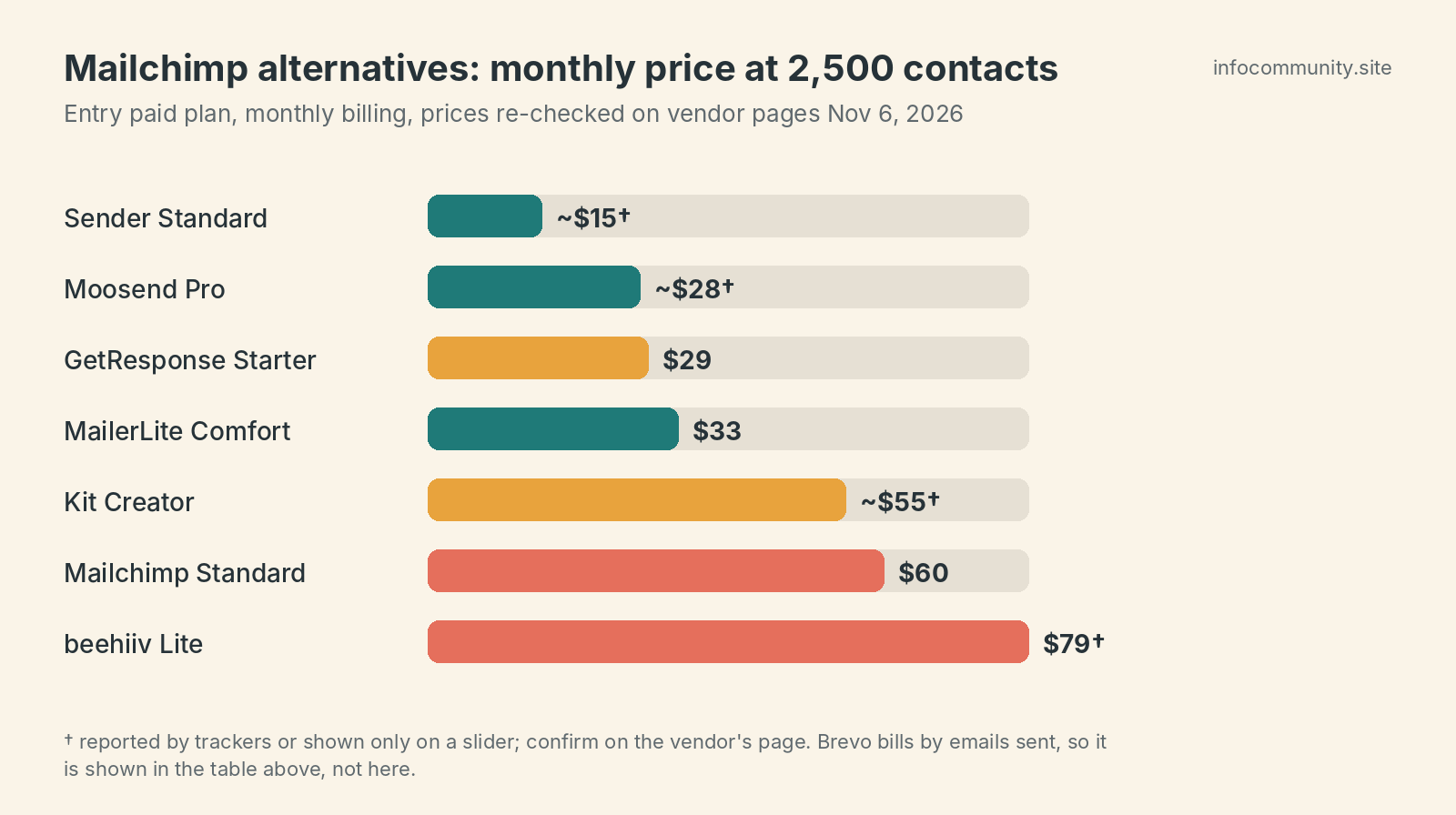

Mailchimp’s cheaper Essentials plan costs $13, $45 and $75 at the same list sizes, but it caps automations at 4 steps, so we use Standard for a like-for-like comparison. We re-checked these Mailchimp prices on Mailchimp’s own pricing page on November 6, 2026 (regular prices; new accounts get 50% off for 12 months), and they also match several independent trackers; see our Mailchimp pricing guide for the sources.
* Brevo bills by monthly email volume, and its cheapest tiers cap stored contacts (500 contacts at the 5,000-email tier, 1,500 at 10,000, 2,500 at 15,000). A 2,500-contact list therefore needs at least the 15,000-email tier ($49/month on Standard) and a 5,000-contact list the 20,000-email tier ($69/month), even if you send less (Brevo’s pricing calculator on brevo.com/pricing, read by us on November 6, 2026).
How we built this table
- We checked the vendors’ official pricing pages on 2026-10-16 where they could be read (MailerLite’s and Kit’s entry tiers). For everything else we used third-party trackers that publish their own access dates (SMTPedia 2026-09-17; Email Vendor Selection 2026-09; thatmarketingbuddy 2026-10-01; EmailToolTester 2026-10-02; sequenzy.com 2026-10-08) and marked those figures †. Trackers sometimes disagree, so confirm on the vendor’s live page before you buy.
- We used month-to-month USD list prices on the cheapest plan that includes automation, before annual discounts, promotions, or add-ons.
- Where a vendor’s slider doesn’t land exactly on 2,500 contacts, the figure is interpolated from adjacent published tiers and marked †.
- This is sourced pricing research, not a product review. We have since confirmed a few limits in our own free accounts (MailerLite, Kit and Brevo, November 5 and 6, 2026); those are dated where they appear.
How to read this table: per-subscriber vs. per-email pricing
Most tools on this list charge per subscriber: your bill grows as your list grows, no matter how often you send. Brevo charges per email sent. If you keep a big list but email it rarely (say, a monthly newsletter to 10,000 people), Brevo’s model can undercut everyone. If you send daily, the math flips. Sender sits in between: per-subscriber pricing with a send cap of 12x your list size on Standard. Know your sending frequency before you pick.
The 7 cheaper Mailchimp alternatives
1. MailerLite — best all-around value
What it costs at scale: Comfort is $12/month at 500 subscribers, $33 at 2,500, $49 at 5,000 (mailerlite.com/pricing, accessed 2026-10-16). That’s roughly half of Mailchimp Standard at every tier we checked. Paid plans have no hard send cap; Comfort allows about 10x your subscriber count per month.
Free plan reality: 250 subscribers and 2,500 emails/month†. Several third-party trackers report it was cut from 500 subscribers in mid-2026, though we could not confirm the change on MailerLite’s own page. Decent, but no longer a standout.
Who it fits: Small businesses and newsletter writers who want Mailchimp-like breadth (automation, landing pages, forms) at half the price.
Honest con: Automation is capped at 3 workflows on the free plan and 50 on Comfort; heavy automation users need the $25+/month Power plan.
2. Sender — the most generous genuinely-free plan
What it costs at scale: Standard is $9/month at 500 subscribers and $39/month at 5,000 on monthly billing (thatmarketingbuddy.com, accessed 2026-10-16). First-year annual billing drops the entry price to $6.30/month, but renewals rise to the full rate.
Free plan reality: 2,500 subscribers, 15,000 emails/month, with automation and segmentation included (sender.net/pricing, accessed 2026-10-16). This is the strongest free tier in this comparison — ten times Mailchimp’s contact ceiling, with features Mailchimp locks behind paid plans. We mention it first among free options because, for a list under 2,500, it is simply the right answer.
Who it fits: Solo operators, nonprofits, and small stores with lists under 2,500 who want real automation at $0.
Honest con: No paid-plan free trial and no published refund policy†; you evaluate the free plan, then commit. The native integration ecosystem is also thinner than MailerLite’s.
3. Brevo — best if you send infrequently
What it costs at scale: Standard starts at $18/month for 5,000 monthly emails and scales by volume: $35 at 10,000 emails, $49 at 15,000, $69 at 20,000 and $89 at 40,000 (our read of Brevo’s pricing calculator, November 6, 2026; earlier summary: dreamlit.ai, citing brevo.com/pricing, accessed 2026-10-16). Because billing is per email, a huge list you email monthly can cost less here than anywhere else.
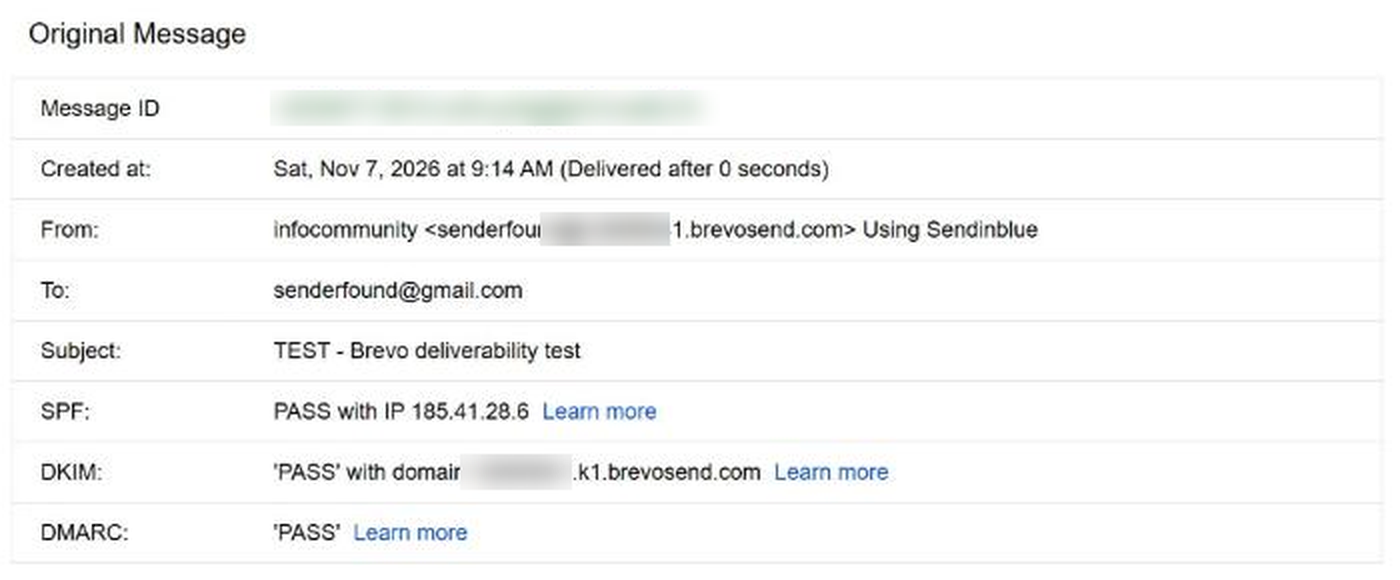
Free plan reality: 300 emails per day and up to 100,000 contacts (both confirmed in our own Brevo account on November 6, 2026). Automation on the Free and Starter plans is limited to 2,000 contacts. A new account has to be validated before it can send anything — our first test on November 6, 2026 returned “Your account needs to be validated in order to send test emails”, and validation took a phone-number check. Once validated, our test email (November 7) reached the Gmail inbox with SPF, DKIM and DMARC passing; like MailerLite and Mailchimp, Brevo replaced our Gmail “From” address with its own sending domain (brevosend.com). The daily cap is the catch — a single campaign to a 5,000-person list takes 17 days.
Who it fits: Businesses with large, infrequently emailed lists, or anyone who also wants transactional email and a basic CRM in one account.
Honest con: The cheapest volume tiers cap stored contacts (500 at the entry tier), which can force you into a higher tier than your send volume alone would require. Removing Brevo branding on Starter costs an extra ~$12/month.
4. Kit — best for creators who monetize
What it costs at scale: Creator is $39/month at 1,000 subscribers and $89†/month at 5,000 (emailvendorselection.com/kit-pricing, accessed 2026-10-16). Not the cheapest on the list — Kit raised its paid prices sharply over the past year†.
Free plan reality: The best free plan for list growth: 10,000 subscribers with unlimited sends, with limited automations and sequences† (kit.com/pricing, accessed 2026-10-16). Nothing else in this comparison comes close at that ceiling.
Who it fits: Creators selling digital products, courses, or paid newsletters, and anyone building an audience who wants to defer paying until the list is real.
Honest con: Kit counts every subscriber toward your tier, including cold ones, and doesn’t auto-prune inactives — list hygiene is on you.
5. beehiiv — best for newsletter-first publishers
What it costs at scale: beehiiv raised prices on October 1, 2026 and renamed its plans (Scale → Lite, Max → Pro), as The Verge reported on October 2, 2026. Lite is now $59/month at 1,000 subscribers, $79† at 2,500, $109 at 5,000 (emailtooltester.com, accessed 2026-10-16; beehiiv.com announcement, accessed 2026-10-16). Cheaper than Mailchimp at small sizes, but the gap narrows as you grow.
Free plan reality: 2,500 subscribers with unlimited sends, but it reportedly lost custom domains in the October 2026 change†.
Who it fits: Publishers building a newsletter-as-business: built-in ad network, paid subscriptions at 0% platform fee, and a recommendation network.
Honest con: It’s a newsletter platform, not a general email marketing tool — ecommerce automation and CRM-style segmentation are not its strength, and removing beehiiv branding requires the $109+/month Pro plan.
6. Moosend — cheapest full-featured paid plan
What it costs at scale: Pro is $9/month at 500 contacts, $24† at 2,000, $48† at 5,000, with unlimited sends and all automation features included at every tier (emailvendorselection.com/moosend-pricing, accessed 2026-10-16). Annual billing takes 20% off; nonprofits get a further 25%.
Free plan reality: There isn’t one. Moosend discontinued its free plan in late 2025†; you get a 30-day trial, no credit card required.
Who it fits: Small businesses that want unlimited sends and full automation at the lowest flat entry price, and don’t need a free tier.
Honest con: Transactional email (order confirmations, password resets) isn’t included in Pro — it requires the custom-priced Moosend+ add-on, which matters for ecommerce.
7. GetResponse — best all-in-one for ecommerce
What it costs at scale: Starter is $19/month at 1,000 contacts, $29 at 2,500, $54 at 5,000, with unlimited sends; the automation-heavy Marketer plan is $59/$69/$95† (ecommerceparadise.com, accessed 2026-10-16). Annual billing saves 18%.
Free plan reality: No published free plan anymore — a 14-day premium trial, then you pay.
Who it fits: Ecommerce operators who want abandoned-cart workflows, funnels, webinars, and email in one subscription instead of three separate tools.
Honest con: The entry Starter plan includes only one custom automation workflow (per its pricing page, November 6, 2026); the realistic buy for ecommerce is Marketer at $59+/month.
Which one should you pick?
- Tiny list (under 2,500), minimal budget: Start with Sender (free, automation included) or Kit if you expect to grow past 2,500 and want to stay free until 10,000. Mailchimp’s 250-contact free plan isn’t competitive here.
- Growing newsletter (2,500–10,000): MailerLite for general value ($33–$49/month at 2,500–5,000). Choose beehiiv instead if ad revenue and paid subscriptions are your model. See our MailerLite vs. Kit breakdown for a closer look at those two.
- Ecommerce: GetResponse Marketer if you want one tool for email, funnels, and webinars; Moosend plus a transactional add-on if you want the lower bill. Budget options like Sender also cover basic abandoned-cart flows.
- Nonprofit: Sender (free to 2,500 contacts) or Moosend, which offers a published 25% nonprofit discount on top of annual savings.
- Big list, infrequent sends: Brevo, because you pay per email, not per subscriber.
FAQ
Is there a free Mailchimp alternative?
Yes, and two are genuinely usable. Sender is free for up to 2,500 subscribers with automation included. Kit’s free Newsletter plan covers 10,000 subscribers with unlimited sends. Mailchimp’s free plan, by contrast, caps at 250 contacts and 500 monthly sends (sources cited above, accessed 2026-10-16).
What is the cheapest Mailchimp alternative overall?
For a paid plan at 500 contacts, Moosend and Sender tie at $9/month — versus $20/month for Mailchimp Standard. At 5,000 contacts, Sender Standard ($39) and Moosend Pro ($48) are the cheapest paid options we found†.
Why is Mailchimp so expensive now?
Since Intuit’s 2021 acquisition, Mailchimp has raised prices repeatedly: Essentials moved from $9.99 to $13, Standard from $14.99 to $20, with a further 11–13% across-the-board increase in April 2026†, and the free plan was cut from 2,000 contacts (pre-2022) to 250 (smtpedia.com, accessed 2026-10-16).
Is Brevo really cheaper than Mailchimp?
It depends on your sending pattern. Brevo bills per email, not per contact. A 10,000-contact list emailed monthly (40,000 sends) costs $89/month on Brevo Standard — competitive. But a 2,500-contact list emailed weekly (about 10,000 sends) is pushed into Brevo’s 15,000-email tier by its stored-contact caps — $49/month on Standard or $25 on Starter — where MailerLite charges $33.
Can I move my list from Mailchimp without losing subscribers?
Yes. Every tool here imports CSV exports, and several (including Kit, on paid plans†) offer free concierge migrations. Always export before canceling — and re-confirm consent requirements if your list is old. Our step-by-step switching guide walks through the MailerLite route.
Do these prices include annual discounts?
No. The table uses month-to-month list prices so you compare like for like. Most tools discount 10–20% for annual prepayment; Sender’s first-year annual discount (30%) does not carry into renewals.
† Price or detail reported by third-party trackers or not published as static text on the vendor’s page (many vendors show prices on an interactive slider). Confirm on the vendor’s live page before you buy.
Sources and method
Prices and plan limits on this page were checked on the dates shown below. Limits we confirmed in our own accounts are dated; screenshots of our MailerLite checks are in our MailerLite vs Kit comparison.
- mailchimp.com (accessed 2026-10-16)
- smtpedia.com (accessed 2026-10-16)
- emailvendorselection.com (accessed 2026-10-16)
- mailerlite.com (accessed 2026-10-16)
- brevo.com (accessed 2026-10-16)
- kit.com (accessed 2026-10-16)
- beehiiv.com (accessed 2026-10-16)
- beehiiv.com (accessed 2026-10-16)
- sender.net (accessed 2026-10-16)
- moosend.com (accessed 2026-10-16)
- getresponse.com (accessed 2026-10-16)