

GivingTuesday lands on December 1, 2026. If your email setup isn’t ready by then, you’ll be building it in the middle of your busiest fundraising month.
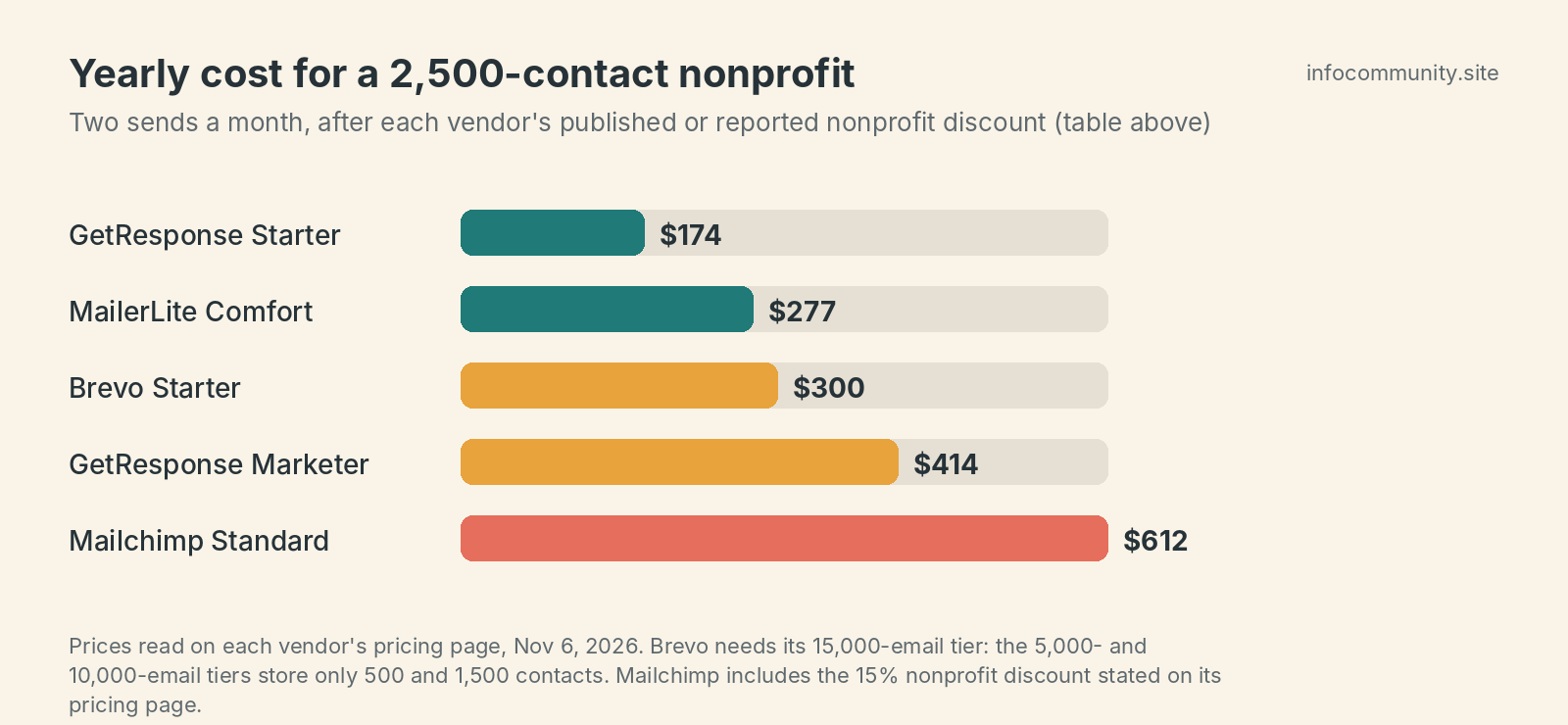
Here is the part nobody tells nonprofit teams: the same 2,500-person supporter list can cost $174 a year on one platform and $612 on another, even after nonprofit discounts. That is a $438 gap, and it is money that could go to the mission instead. Choosing the best email marketing for nonprofits is really a pricing question wrapped in a features question, and the biggest discount is not always the cheapest bill.
Disclosure: This article may contain affiliate links. If you sign up through them, we may earn a commission at no extra cost to you. It never affects our rankings or verdicts. Learn more →
TL;DR
- Lowest bill with full automation included: MailerLite, with a reported 30% nonprofit discount (about $277 a year at 2,500 contacts†).
- Biggest percentage off: GetResponse at 50%, but you must place its logo on your website within 4 weeks or the discount shrinks.
- Cheapest for a large list you rarely email: Brevo, which charges per email sent instead of per contact.
- Free start: Kit covers up to 10,000 subscribers for simple newsletters.
- Mailchimp: only if you already live in it. Even with a reported 15% discount†, it was the most expensive option in our example.
The $438 gap: one list, five different bills
Here is what the same nonprofit list costs for a year on each platform, after the nonprofit discount where one is available.
| Platform and plan | List price per month | After nonprofit discount | Per year |
|---|---|---|---|
| GetResponse Starter | $29 | $14.50 (50% off) | $174 |
| MailerLite Comfort | $33 | $23.10 (30% off) | $277 |
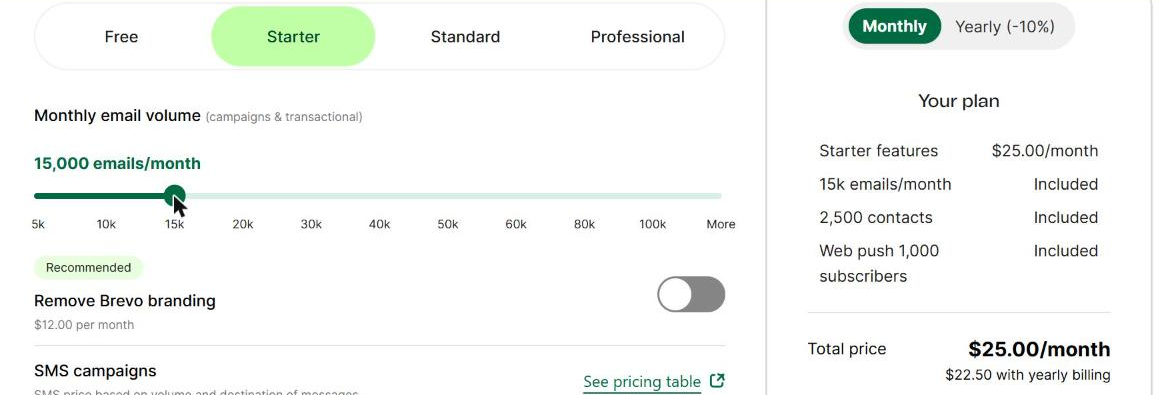
| Brevo Starter (15,000-email tier) | $25 | $25 (no discount used) | $300 |
| GetResponse Marketer (full automation) | $69 | $34.50 (50% off) | $414 |
| Mailchimp Standard | $60 | $51 (15% off) | $612 |
How we calculated
- Example list: 2,500 contacts, two emails a month to the whole list (5,000 emails a month), billed monthly. Discounts applied as reported by each vendor or by the sources listed below.
- This is not a like-for-like feature comparison. Brevo Starter caps automation at 2,000 contacts (confirmed in our own Brevo account on November 6, 2026); GetResponse Starter includes only one custom automation workflow (per its pricing page, November 6, 2026); Mailchimp Standard and GetResponse Marketer include fuller automation.
- List prices at 2,500 contacts come from third-party trackers (marked †), because most vendors show prices on an interactive slider. Mailchimp’s figure matches several trackers in our Mailchimp pricing guide.
- Excluded: annual-billing discounts, taxes, add-ons such as SMS credits or extra users, and any price changes after the dates listed in our sources.
Two lessons jump out. First, a smaller percentage off can still be the cheaper bill: MailerLite’s 30% beats Mailchimp’s 15% by hundreds of dollars a year on this list. Second, the pricing model matters more than the discount: GetResponse’s 50% discount made it the cheapest bill here, but only if you accept its logo condition. Brevo charges by emails sent, yet its lower tiers also cap stored contacts (500 on the 5,000-email tier and 1,500 on the 10,000-email tier, per Brevo’s help center, and 2,500 on the 15,000-email tier in Brevo’s pricing calculator), so a 2,500-contact list needs the 15,000-email tier ($25/month on Starter, read on November 6, 2026).
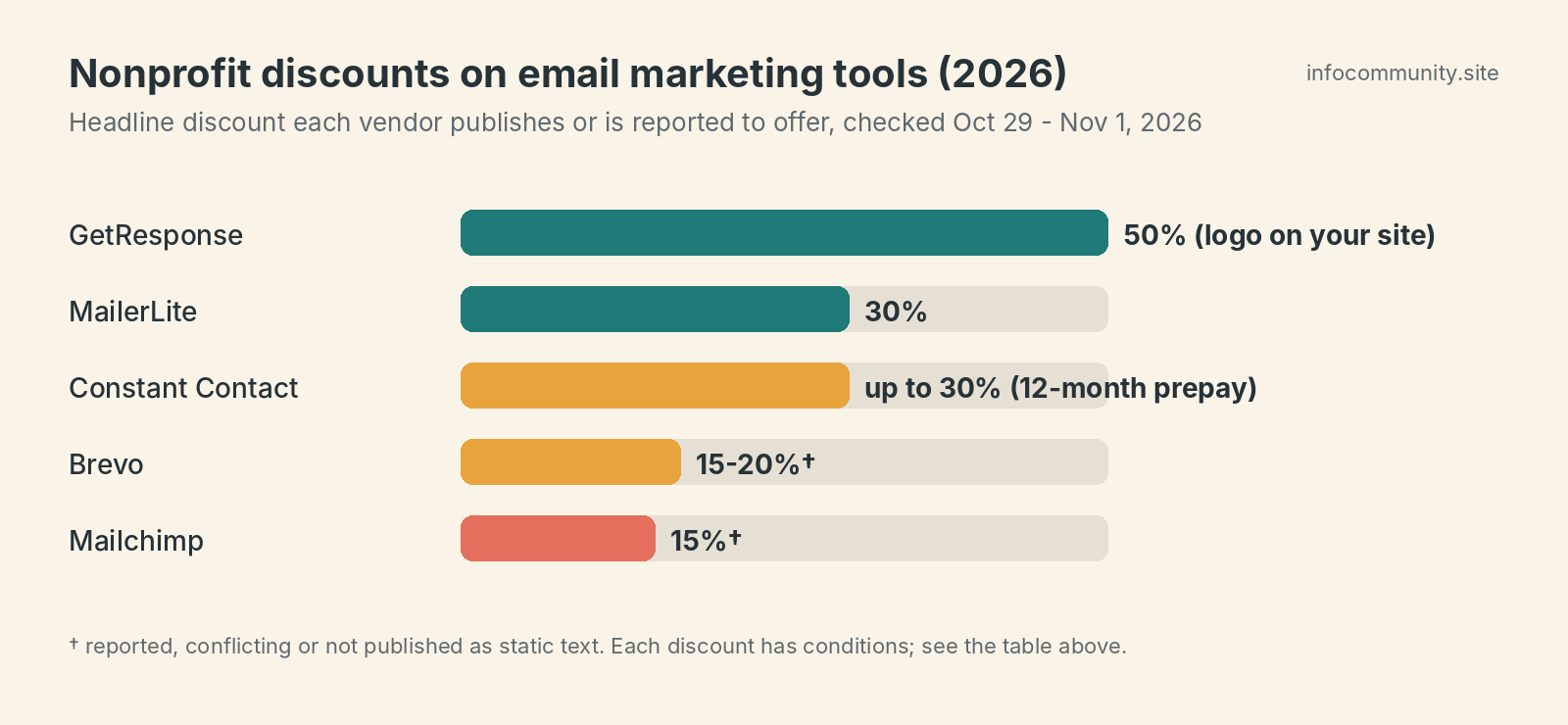
Nonprofit discounts at a glance
| Tool | Nonprofit discount | The catch | Free plan |
|---|---|---|---|
| GetResponse | 50% | Place its logo on your site within 4 weeks; it checks monthly and reduces or removes the discount if it cannot find it | None (14-day trial)† |
| MailerLite | 30% on its pricing page (some trackers report 20%†) | New accounts go through an approval review | 250 subscribers |
| Constant Contact | Up to 30% with a 12-month prepay | No discount on monthly billing; you need proof of nonprofit status | Trial only |
| Mailchimp | 15% (on its pricing page) | Sign up free, then ask Billing with your username and website; unsubscribed contacts still count unless archived | 250 contacts / 500 sends (tested) |
| Brevo | 15–20% reported† | Some sources say it applies only to higher plans† | 300 emails a day |
| Kit | None published | Free plan is generous, but automation is limited† | Up to 10,000 subscribers |
| beehiiv | None published | Paid plans start at $59 a month after the October 2026 repricing | Up to 2,500 subscribers |
The best email marketing for nonprofits, tool by tool
1. GetResponse: the biggest discount, with one string attached
GetResponse’s own nonprofit page offers 50% off to qualifying, non-political nonprofit organizations. You send proof of status and then choose a plan. Its pricing page for nonprofits says the account can hold up to 100,000 contacts.
The string: if you take the 50% discount, GetResponse asks you to place its logo on your website within four weeks, and it scans for it every month. If it cannot find the logo, the discount is reduced or removed from the next billing cycle. Plan for a small “partners” section on your site before you apply.
How long it lasts is unclear. GetResponse’s pages describe the discount as lifetime, while TechSoup’s FAQ for its own program says 24 months. Ask which applies to you before you build your budget around year three.
Prices we read ourselves: on November 6, 2026, GetResponse’s pricing slider showed Starter at $29 and Marketer at $69 a month for 2,500 contacts before the discount, with a 14-day trial that needed no card. Starter allows only one custom automation workflow; a welcome series plus a donation follow-up needs Marketer. Our test email from a Gmail sender address landed in spam with DMARC failing, so send from your organization’s own domain.
Who it fits: nonprofits that will use webinars for virtual fundraisers or volunteer training, and can afford the Marketer tier. Several sources say the program also extends to many churches.
See GetResponse’s plans → Read GetResponse’s nonprofit terms →
2. MailerLite: the best balance of price and simplicity
MailerLite lists a 30% nonprofit discount on its pricing page, though some trackers report 20%, so confirm the rate when you apply†. Even at 30%, the final bill is often the lowest of the full-featured options because its list prices are already low. At 2,500 contacts that is roughly $23 a month after the discount in our example†.
It includes a drag-and-drop editor, landing pages and a visual automation builder, which is enough for the three flows most nonprofits need: a welcome series, a first-gift thank-you, and a lapsed-donor re-engagement sequence.
The catch: account approval. MailerLite reviews new accounts before you can send, and approval complaints are the most repeated theme in public reviews (see “What users report” below). Apply early, with your nonprofit documentation ready, and do not import a cold list on day one.
3. Constant Contact: best if events and phone support matter
Constant Contact’s nonprofit discount is the clearest on paper but only works if you prepay: up to 30% off with a 12-month prepay, with a smaller discount reported for six months†. There is no discount on monthly billing. It asks for proof of status (such as an IRS determination letter), and its own guidance says to confirm your nonprofit pricing before you buy a prepay plan†.
Plans start at $12 a month for up to 500 contacts, and its Standard plan starts at $35†. The draw is built-in event management (RSVPs and reminders) and phone support. If your calendar is full of galas and volunteer orientations, that may justify the price. If you mainly send a newsletter, it is more than you need.
4. Mailchimp: familiar, but the discount does not fix the math
Mailchimp’s own pricing page (checked November 6, 2026) offers nonprofits and charities 15% off: you sign up for a free account, then contact its Billing team with your username and a link to your organization’s website. Ask before you pay, because it generally cannot be applied retroactively†.
The bigger issue is the billing model. According to pricing trackers, unsubscribed contacts count toward your plan unless you archive them, which quietly inflates the bill for nonprofits that collect event lists and petition signups for years. And the cheaper Essentials plan caps automation at 4 steps†, so multi-step donor journeys usually need Standard. See our full Mailchimp pricing guide, our list of cheaper Mailchimp alternatives, and the step-by-step switch to MailerLite if you decide to move.
5. Brevo: best for big lists you email occasionally
Brevo prices by emails sent, not contacts stored. The free plan allows 300 emails a day and up to 100,000 contacts, and the Starter plan begins at $9 a month for 5,000 emails. That entry tier stores only 500 contacts, and the 10,000-email tier 1,500, per Brevo’s help center; a 2,500-contact list needs the 15,000-email tier, which costs $25 a month on Starter (Brevo’s pricing calculator, November 6, 2026). Removing the Brevo logo on Starter is a $12/month add-on. Automation on Free and Starter is limited to 2,000 contacts; unlimited automation starts on Standard (all three limits confirmed in our own Brevo account on November 6, 2026). For a long-lived donor database you email once a month, that model can be dramatically cheaper than per-contact tools.
The catch: the daily cap. At 300 emails a day, a single campaign to a 5,000-person list takes about 17 days on the free plan, which is a problem for a GivingTuesday blast. Plan on a paid plan for burst sends. Its nonprofit discount is reported at 15–20% and may apply only to higher plans†, so the real value is the pricing model.
6. Kit and beehiiv: good tools, no published nonprofit discount
Neither publishes a nonprofit discount program. Kit’s free plan covers up to 10,000 subscribers, which suits a simple newsletter, while paid plans start at $39 a month for 1,000 subscribers (confirmed in our own Kit account on November 6, 2026). beehiiv’s free plan covers up to 2,500 subscribers, and paid plans start at $59 a month. If your nonprofit runs a content-driven newsletter, either can work, but you will pay full price where others offer 30–50% off. See our Kit alternatives and MailerLite vs Kit comparisons.
What users report (and how to read it)
We looked at public review pages on Capterra and Trustpilot and at review summaries on comparison sites. This is a read of recurring themes, not a survey, and we do not quote individual reviewers. We link the sources so you can read the reviews yourself.
- MailerLite: strict account approval is the most repeated complaint. Capterra’s summary lists it as a recurring con, and some Trustpilot reviewers describe rejected or suspended accounts. The same pages also contain many reviews praising live-chat support. Practical takeaway: apply early, have your documentation ready, and send your first campaigns to an engaged list.
- Brevo: switching from Constant Contact for cost. Some reviewers on Capterra’s Brevo page list Constant Contact as the tool they switched from, citing price. Capterra’s summary also notes confusing account controls as a recurring con†.
- Support matters more than features for volunteer-run teams. If one person manages email for a few hours a week, live chat and a clear editor are worth more than a longer feature list. Check support options on each plan before you commit.
Review pages change daily and reflect the reviewers who chose to write, so treat them as a prompt for questions to ask the vendor, not as a verdict.
5 mistakes that quietly cost nonprofits money
- Paying before you ask for the discount. Some vendors cannot apply it retroactively†. Apply first, then buy.
- Choosing by percentage instead of the yearly bill. The $438 gap above is the proof.
- Paying for contacts you can’t email. On Mailchimp, unsubscribed contacts count until you archive them, according to pricing trackers.
- Forgetting GetResponse’s logo rule. Miss the four-week window and the discount can drop.
- Starting setup in late November. New-account approvals can take at least a day (reviewers cite about 24 hours†), and a free-plan send cap can stretch a big campaign over weeks. If GivingTuesday is your target, set up now.
How to apply for a nonprofit discount
- Gather proof. In the United States that is usually your IRS determination letter (501(c)(3), or 501(c)(6) for some vendors).
- Ask before you subscribe. Request the discount at signup or through support, and get it confirmed in writing.
- Read the renewal terms. Ask how long the discount lasts and what you must do to keep it (for GetResponse, the logo).
- Re-check once a year. Programs and prices change, so confirm after any plan change.
Which is the best email marketing for nonprofits like yours?
- How big is your list, and how often do you send? Under about 2,500 contacts with regular sends: MailerLite. A large list emailed occasionally: Brevo.
- Do you run events or webinars? GetResponse (webinars) or Constant Contact (events and phone support).
- Who manages it? If a volunteer has two hours a week, choose the simplest editor over the longest feature list.
Whatever you choose, apply for the discount before you pay, and archive contacts you can no longer email. Those two habits save most nonprofits more than any feature comparison.
FAQ
Do churches and community groups qualify for nonprofit discounts?
It depends on the vendor. GetResponse’s blog says its program also extends to many church organizations; check each vendor’s terms and have your documentation ready.
What is the cheapest email marketing for a small nonprofit?
For a list under a few hundred contacts, a free plan (Kit, MailerLite or Brevo) costs nothing. For a 2,500-contact list with two sends a month, GetResponse Starter came out cheapest in our example at about $174 a year after its 50% nonprofit discount (which requires its logo on your site), followed by MailerLite Comfort at about $277 and Brevo Starter at about $300.
Is a bigger discount always cheaper?
No. In our example, MailerLite’s 30% was cheaper than Mailchimp’s reported 15%, and GetResponse’s 50% made it the cheapest bill overall.
Can I stack a nonprofit discount with annual billing?
Terms differ by vendor and change often, so ask support in writing. We did not find a reliable, current answer for every tool.
More guides: Mailchimp pricing in 2026 · Mailchimp alternatives · MailerLite vs Kit · beehiiv vs Substack
† Price or detail reported by third-party trackers or guides, or not published as static text on the vendor’s page (many vendors show prices on an interactive slider). Confirm on the vendor’s live page before you buy.
Sources and method
Discount terms and prices on this page come from the vendor pages and independent sources below, not from our own hands-on testing. We have not tested these tools for nonprofit use ourselves; where we do, we will say so and show screenshots.
- Brevo help center, About Brevo’s pricing plans: Starter contact storage by email tier (accessed 2026-11-06).
- getresponse.com, nonprofit page (accessed 2026-11-02)
- getresponse.com, nonprofit pricing (accessed 2026-11-02)
- support.techsoup.org (accessed 2026-11-02)
- blog.getresponse.com (accessed 2026-11-02)
- mailerlite.com (accessed 2026-10-17)
- emailtooltester.com (accessed 2026-11-02)
- sendpulse.com (accessed 2026-11-02)
- capterra.com, MailerLite reviews (accessed 2026-11-02)
- capterra.com, Brevo reviews (accessed 2026-11-02)
- trustpilot.com, MailerLite reviews (accessed 2026-11-02)
- InfoCommunity: Mailchimp pricing in 2026